Choose a mode and enter the angle (or the arc length ratio).
Table of Contents
-
What you can do on this page
-
What is this calculation used for?
-
How to Use
-
Formulas and figures
-
Symbols and terms
-
Good to know before you start
-
How to calculate it in Excel
-
How to calculate it in Google Sheets
-
How to calculate it in Python
-
How to write it in LaTeX and other math languages (copy and paste)
-
How to have ChatGPT do the calculation
-
DataChef Features
-
Related Features
-
NumberChef Calculators List
What you can do on this page
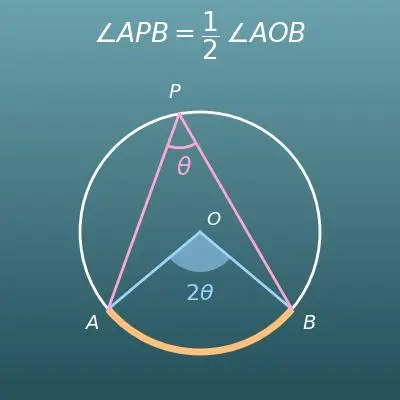
- Using the inscribed angle theorem (an inscribed angle is half the central angle on the same arc), you can find the central angle from an inscribed angle (twice) or the inscribed angle from a central angle (half) right away. Angles that do not divide evenly, such as \(\dfrac{250}{7}^\circ\), are shown both exactly (as a fraction) and as a decimal
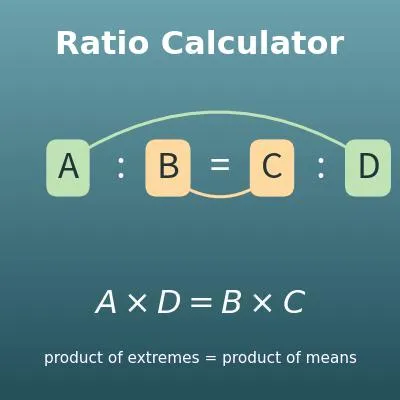
- In the same circle, when arc AB : arc CD \(= m : n\), the inscribed angles are in the same ratio (inscribed angles are proportional to arc length). Use this to find one inscribed angle from the other
- Opposite angles of a quadrilateral inscribed in a circle add up to \(180^\circ\). Use this to find the opposite angle from one angle
- The result comes with a figure of the circle, so you can see where the arc, the central angle and the inscribed angle are, and check that inscribed angles on the same arc are equal wherever you look from (in the arc ratio mode, only when the two arcs are too large to fit in one circle, the figure is left out and just the numbers are shown)
- The figures with the formulas explain why the theorems are true, such as "an angle inscribed in a semicircle is \(90^\circ\)" (Thales' theorem)
What is this calculation used for?
A ship near the coast can find its position by measuring the angle between two landmarks on shore (such as lighthouses). By the converse of the inscribed angle theorem, all the points that see two landmarks at the same angle lie on one circular arc. Measure the angles for two pairs of landmarks, and the ship is at the single point where the two arcs cross (a classic method called a horizontal sextant angle fix, plotted with a station pointer, or three-arm protractor).
It is still taught to ship officers as a backup for when GPS cannot be used.
In soccer, the angle between the two goalposts as seen by the shooter shows how wide the goal looks. By the inscribed angle theorem, all the spots with the same angle lie on one arc through the two posts. Moving sideways away from the center of the goal along this arc keeps the angle the same.
In sports analytics, this "shooting angle" is actually used as one of the main measures that explain shot success rates.
The converse of Thales' theorem (if the inscribed angle is 90°, the chord is a diameter) makes it easy to find the center of a round board or a cylinder. Set the corner of a carpenter's square on the edge of the circle; the line joining the two points where its sides cross the edge is a diameter. Do this twice from different directions, and the center is where the two diameters cross.
A woodworker's center finder is this theorem turned into a tool.
The larger the angle between the two ends of the stage, the wider the stage looks. By the inscribed angle theorem, seats that see the stage at the same angle lie on the same arc, so arranging the seats in arcs keeps the view similar along each row.
From the semicircular theaters of ancient Greece to modern concert halls, seating that curves in arcs puts this property of geometry to work (real designs also take acoustics, exit routes and other factors into account).
Formulas and figures
Symbols and terms
Symbols
| \(\angle\) | angle | The symbol for an angle. \(\angle APB\) is the angle with its vertex at point \(P\), formed by the two lines from \(P\) to \(A\) and \(B\). The middle letter is the vertex. |
| \(\overset{\frown}{AB}\) | arc A B | The symbol for arc AB, the part of the circle between two points \(A\) and \(B\) on it. The curved mark above the letters shows that it is the curved arc, not the straight segment AB. |
| \(x,\ c\) | ex, see | This page writes the inscribed angle as \(x\) and the central angle as \(c\). Using \(x\) for an unknown number is a familiar habit from textbooks, and \(c\) is the first letter of "center". |
| \(O\) | oh | The letter for the center of the circle. It is said to come from the first letter of "origin". The central angle is the angle with its vertex at \(O\). |
| \(P,\ Q\) | pee, cue | Letters for points on the circle, by the habit of using \(P\) for "point" and the next letter, \(Q\). The inscribed angle is the angle with its vertex at \(P\) or \(Q\). |
| \(m : n\) | m to n | The ratio of two amounts. On this page it is the ratio of the lengths of arc AB and arc CD. \(2 : 3\) tells you that arc CD is \(\dfrac{3}{2}\) times as long as arc AB. |
| \(^\circ\) | degrees | The symbol for the degree, a unit of angle. One full turn divided into 360 equal parts is \(1^\circ\). It is said that 360 was chosen for one turn because it has many factors and is easy to divide evenly. |
Terms
| inscribed angle | The angle formed by two chords drawn from one point on a circle to the ends \(A\) and \(B\) of an arc. It always goes with the arc it looks at (its intercepted arc), as in "the inscribed angle on arc AB". Wherever you move the vertex on the circle (off arc AB), its size stays the same. |
| central angle | The angle formed by the two radii drawn from the center \(O\) to the ends \(A\) and \(B\) of an arc. Each arc has only one central angle, and it is exactly twice the inscribed angle on the same arc. |
| inscribed angle theorem | The theorem that "an inscribed angle is half the central angle on the same arc" and "inscribed angles on the same arc are all equal". It is the central theorem of the circles unit in high school Geometry, and its proof uses isosceles triangles and the exterior angle of a triangle. |
| arc | The part of a circle between two points on it. Two points split the circle into two arcs; the shorter one is the minor arc and the longer one is the major arc. Plain "arc AB" usually refers to the shorter one (the minor arc). |
| major arc | When two points split a circle in two, the arc that is longer than a semicircle. Its central angle is more than \(180^\circ\). The inscribed angle theorem holds for either arc. |
| minor arc | When two points split a circle in two, the arc that is shorter than a semicircle. Its central angle is less than \(180^\circ\). The inscribed angle theorem holds for either arc. |
| chord | A straight line segment joining two points on a circle. An arc is the curved path along the circle, while a chord is the straight shortest path between the two points. Arc length is proportional to the inscribed angle, but chord length is not. |
| diameter | A chord through the center of a circle. It is the longest chord, twice as long as the radius. The arc on a diameter is exactly a semicircle, and the inscribed angle on it is always \(90^\circ\) (Thales' theorem). |
| radius | The distance (or the segment) from the center of a circle to a point on it. All radii of one circle are equal, and the isosceles triangles this creates are the key to proving the inscribed angle theorem. |
| Thales' theorem | The theorem that "an angle inscribed in a semicircle is \(90^\circ\)". It is a special case of the inscribed angle theorem (when the central angle is \(180^\circ\)). It is named after the ancient Greek mathematician Thales, and its converse (if the inscribed angle is \(90^\circ\), the chord is a diameter) is also true. |
| inscribed quadrilateral | A quadrilateral whose four vertices all lie on one circle (also called a cyclic quadrilateral). "Inscribed" tells you it fits exactly inside the circle. Its opposite angles have the special property of adding up to \(180^\circ\). |
| opposite angles | Angles across from each other in a quadrilateral. In quadrilateral ABCD, \(\angle A\) and \(\angle C\) are one pair of opposite angles, and \(\angle B\) and \(\angle D\) are the other. |
| isosceles triangle | A triangle with two sides of equal length. The two angles opposite the equal sides (the base angles) are equal. It shows up in the proof of the inscribed angle theorem because all radii are equal. |
| proportional | A relation where, when one amount becomes 2 or 3 times larger, the other also becomes 2 or 3 times larger. Arc length and central angle, and arc length and inscribed angle, are both proportional. |
Good to know before you start
Here is what helps you use the calculation on this page with real understanding, not just by pressing the button.
If you get stuck, going back to these topics is the fastest way forward.
| Circle vocabulary (Grades 3–7) |
|
| Angles and turns (Grade 4) |
|
| Isosceles triangles (high school Geometry) |
|
| Interior and exterior angles of a triangle (Grade 8) |
|
| Ratios and proportional relationships (Grades 6–7) |
|
| Division and fractions (Grades 5–7) |
|
How to calculate it in Excel
| Inscribed angle (degrees) | 50 |
| Central angle (degrees) | =B1*2 |
| Central angle (degrees) | 100 |
| Inscribed angle (degrees) | =B1/2 |
| Ratio for arc AB, m | 2 |
| Ratio for arc CD, n | 3 |
| Inscribed angle on arc AB (degrees) | 30 |
| Inscribed angle on arc CD (degrees) | =B3*B2/B1 |
| Angle of the quadrilateral ∠A (degrees) | 110 |
| Opposite angle ∠C (degrees) | =180-B1 |
"*" is multiplication and "/" is division.
The first table finds the central angle from an inscribed angle of 50°; the answer is 100. The second goes the other way and finds the inscribed angle 50 from a central angle of 100°.
The third table is for arc AB : arc CD = 2 : 3 with an inscribed angle of 30° on arc AB. Inscribed angles are proportional to arc length, so the answer is 30 × 3 ÷ 2 = 45.
The fourth table is for a quadrilateral inscribed in a circle: enter 110 for ∠A and the opposite angle ∠C is 70.
How to calculate it in Google Sheets
| Inscribed angle (degrees) | 50 |
| Central angle (degrees) | =B1*2 |
| Central angle (degrees) | 100 |
| Inscribed angle (degrees) | =B1/2 |
| Ratio for arc AB, m | 2 |
| Ratio for arc CD, n | 3 |
| Inscribed angle on arc AB (degrees) | 30 |
| Inscribed angle on arc CD (degrees) | =B3*B2/B1 |
| Angle of the quadrilateral ∠A (degrees) | 110 |
| Opposite angle ∠C (degrees) | =180-B1 |
How to calculate it in Python
from fractions import Fraction

# Inscribed angle -> central angle (the central angle is twice the inscribed angle)
inscribed_angle = Fraction(250, 7)   # a fraction such as 250/7 degrees can be written as is
central_angle = inscribed_angle * 2
print(f"Inscribed angle {inscribed_angle}° -> central angle {central_angle}° ≈ {float(central_angle):.2f}°")

# Central angle -> inscribed angle (the inscribed angle is half the central angle)
central_angle = Fraction(100)
inscribed_angle = central_angle / 2
print(f"Central angle {central_angle}° -> inscribed angle {inscribed_angle}°")

# Arc length ratio -> inscribed angle (inscribed angles are proportional to arc length)
arc_ab, arc_cd = Fraction(2), Fraction(3)   # arc AB : arc CD = 2 : 3
angle_ab = Fraction(30)                     # inscribed angle on arc AB
angle_cd = angle_ab * arc_cd / arc_ab
print(f"Arc ratio {arc_ab}:{arc_cd}, inscribed angle {angle_ab}° -> other inscribed angle {angle_cd}°")

# Opposite angles of a quadrilateral inscribed in a circle (they add up to 180 degrees)
angle_a = Fraction(110)
angle_c = 180 - angle_a
print(f"∠A = {angle_a}° -> opposite angle ∠C = {angle_c}°")
How to write it in LaTeX and other math languages (copy and paste)
x = c / 2
x = \frac{c}{2}
<math xmlns="http://www.w3.org/1998/Math/MathML" display="block">
  <mrow>
    <mi>x</mi>
    <mo>=</mo>
    <mfrac>
      <mi>c</mi>
      <mn>2</mn>
    </mfrac>
  </mrow>
</math>
x = c/2
x = c/2
x := c/2;
x = c/2;
x = c/2
∠APB = ∠AQB
\angle APB = \angle AQB
<math xmlns="http://www.w3.org/1998/Math/MathML" display="block">
<mrow>
<mo>∠</mo><mi>A</mi><mi>P</mi><mi>B</mi>
<mo>=</mo>
<mo>∠</mo><mi>A</mi><mi>Q</mi><mi>B</mi>
</mrow>
</math>
/_ APB = /_ AQB
angleAPB == angleAQB
angleAPB = angleAQB;
angleAPB == angleAQB
∠APB = ∠AQB
∠APB = 90°
\angle APB = 90^{\circ}
<math xmlns="http://www.w3.org/1998/Math/MathML" display="block">
<mrow>
<mo>∠</mo><mi>A</mi><mi>P</mi><mi>B</mi>
<mo>=</mo>
<msup><mn>90</mn><mo>°</mo></msup>
</mrow>
</math>
/_ APB = 90^circ
angleAPB == 90 Degree
angleAPB = 90;
angleAPB = 90;
∠APB = 90°
x₁ : x₂ = m : n
x_1 : x_2 = m : n
<math xmlns="http://www.w3.org/1998/Math/MathML" display="block">
  <mrow>
    <msub><mi>x</mi><mn>1</mn></msub>
    <mo>:</mo>
    <msub><mi>x</mi><mn>2</mn></msub>
    <mo>=</mo>
    <mi>m</mi>
    <mo>:</mo>
    <mi>n</mi>
  </mrow>
</math>
x_1 : x_2 = m : n
x1/x2 == m/n
x1/x2 = m/n;
x1/x2 == m/n
x_1 : x_2 = m : n
∠A + ∠C = 180°
\angle A + \angle C = 180^{\circ}
<math xmlns="http://www.w3.org/1998/Math/MathML" display="block">
<mrow>
<mo>∠</mo><mi>A</mi>
<mo>+</mo>
<mo>∠</mo><mi>C</mi>
<mo>=</mo>
<msup><mn>180</mn><mo>°</mo></msup>
</mrow>
</math>
/_ A + /_ C = 180^circ
angleA + angleC == 180 Degree
angleA + angleC = 180;
angleA + angleC == 180
∠A + ∠C = 180°
How to have ChatGPT do the calculation
You are a calculation assistant for math (plane geometry and properties of circles). Do the following calculation by actually running Python code, and base your answer only on the numbers from the execution result (do not answer by mental math or guessing).

Using the inscribed angle theorem (an inscribed angle is half the central angle on the same arc), show each of the following.
1. The central angle when the inscribed angle is 250/7° (both as a simplified fraction and as a decimal)
2. The inscribed angle when the central angle is 100°
3. In the same circle, with arc AB : arc CD = 2 : 3 and an inscribed angle of 30° on arc AB, the inscribed angle on arc CD (use the fact that inscribed angles are proportional to arc length)
4. In a quadrilateral inscribed in a circle with ∠A = 110°, the opposite angle ∠C (use the fact that opposite angles add up to 180°)

In Python, use the fractions module from the standard library to calculate exactly, and show the formulas you used and the numbers from the execution result.
How to Use
-
1Enter your numbersType the numbers you want to calculate with into the input fields
-
2CalculatePress the "Calculate" button
-
3Check the resultThe result appears on the spot. The same page also explains the idea behind the calculation and the formula
DataChef Features

No technical knowledge required.
Intuitive and user-friendly operation.

Can be used without registering personal information.

Automatic file deletion by clicking "download".

and rapid file conversion.
No attribution required.

No need to contact us for commercial use permission.
Related Features
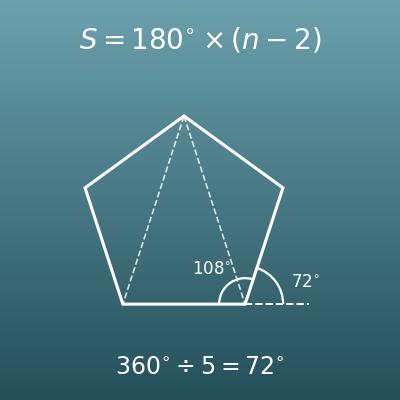
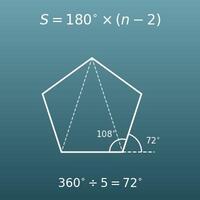
Polygon Angle Calculator (Sum of Interior and Exterior Angles, Regular Polygons)
Finds the interior angle sum 180° × (n − 2), the exterior angle sum 360° and each angle of a regular polygon, with a figure that splits it into triangles
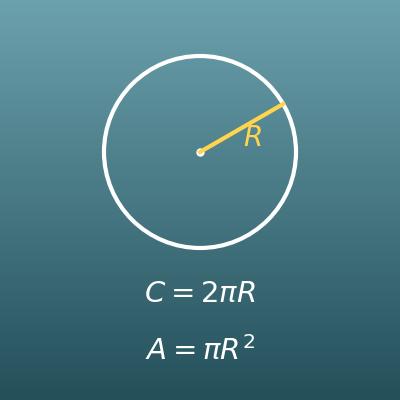
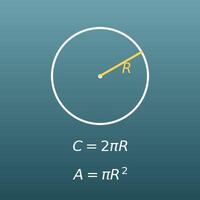
Circle Calculator (Radius, Diameter, Circumference and Area)
Enter any one of radius, diameter, circumference or area to get the other three (it can also work back to the radius)
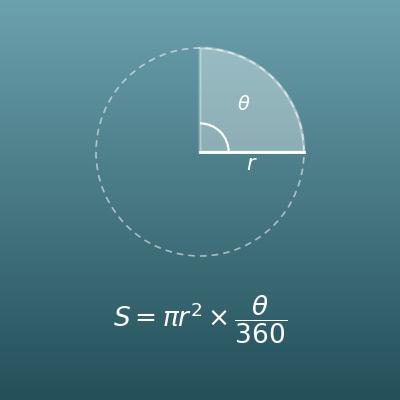
Area of a Sector Calculator (from Radius and Central Angle)
Enter the radius and central angle to get the area of a sector, in degrees or radians
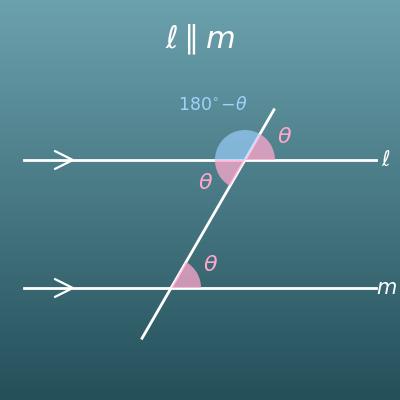
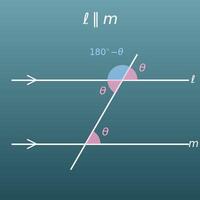
Parallel Lines and Angles Calculator (Corresponding, Alternate Interior and Vertical Angles)
Finds all eight angles formed by two parallel lines and a transversal from one angle, with a color-coded figure of how they are related